

Hayley Fowler
December 26, 2025
NASCAR Contracts Sped Up Team's Financial Woes, Jury Told

6 min
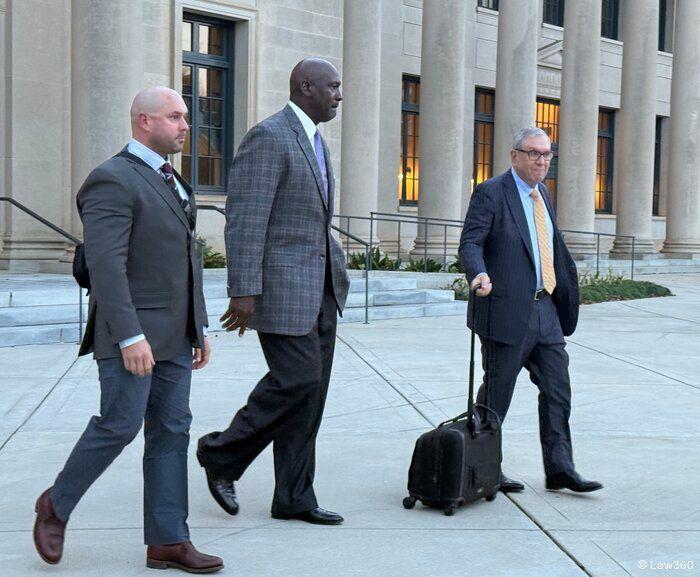
Image source: Unknown

AI-made summary
- During an antitrust trial in North Carolina, Bob Jenkins, owner of Front Row Motorsports, testified that his team has not turned a profit in 22 years, with losses worsening after NASCAR introduced the charter system in 2016
- Jenkins and Michael Jordan's 23XI Racing allege that NASCAR's charter agreements restrict competition and maintain a monopoly
- Jenkins stated that while the charter system aimed to provide financial stability, the contract terms have hindered teams, leading most to sign unfavorable 2025 agreements under pressure.
The longtime owner of a race team suing NASCAR for antitrust violations alongside fellow team owner Michael Jordan told a federal jury in North Carolina Wednesday that his team has never turned a profit in 22 years, with the losses allegedly worsening after the advent of the charter system.
Michael Jordan (center) and his attorney, Jeffrey L. Kessler of Winston & Strawn (right), retire from the Charles R. Jones federal courthouse in Charlotte, North Carolina, after the third day of an antitrust trial against NASCAR. (Hayley Fowler | Law360) NASCAR created the charter system in 2016 at the behest of its teams, giving them guaranteed entry into every Cup Series race and a cut of the revenue, the jury heard. But plaintiffs Front Row Motorsports and Jordan's 23XI Racing claim NASCAR used the charter contracts to squeeze out competition and clamp down on its monopoly.
Bob Jenkins, owner of Front Row, told a jury in Charlotte that he advocated for the charter system at its inception, saying he saw it as a step in the right direction for many teams struggling to survive amid the skyrocketing costs of building a car and getting it to the tracks. The contracts accompanying those charters, however, have impeded that progress, he said.
When NASCAR attorney Lawrence Buterman of Latham & Watkins LLP questioned why Jenkins wouldn't just sell his charters for an estimated $60 million at the end of 2024 if the losses were so bad, Jenkins said that wasn't the point.
"If I want to be in premier stock car racing, I've got to take their deal," he said. "And that's what we're here to change."
Jenkins' testimony came on the third day of Front Row and 23XI's antitrust trial in which they claim NASCAR has illegally maintained its monopoly on premier stock car racing. U.S. District Judge Kenneth D. Bell punctuated the proceedings with a benchslap, saying NASCAR's counsel had twice ignored his directives that branded certain testimony as off limits.
"These violations of court orders will not occur again without significant downside," Judge Bell said out of earshot of the jury before adjourning court.
The antitrust case turns in large part on NASCAR's charter contracts, which commenced in 2016 and had to be renegotiated heading into 2025. 23XI and Front Row claim NASCAR used the agreements to tamp down competition — by tying up tracks, limiting teams' ability to race outside the circuit and imposing technical parameters on the cars.
On Wednesday, Jenkins corrected Buterman for conflating the charter system with the agreements that govern it. The system, he clarified, is good because it was designed to afford the teams more financial stability. It's the contract terms that are the problem, he told the jury.
Jenkins testified that after more than two years of contentious bargaining over the 2025 agreements, NASCAR sent the owners a deal on Sept. 6, 2024, and gave them just a few hours to sign it or risk losing their charters.
"It honestly hurt," Jenkins said of the offer, which he said gave the teams more money but went "virtually backwards in so many ways" from the 2016 contracts.
NASCAR "knew we would have to blindly sign it," he said. In the end, 13 of the 15 teams took the deal because they were unwilling to risk their hundreds of millions of dollars of investment, no matter how bad the terms allegedly were, Jenkins said.
Only 23XI and Front Row opted out. But in his conversations with a handful of the other owners, Jenkins said that "not a single owner said, 'I was happy to sign it' — not a single one."
Jenkins did, however, sign the original 2016 contracts, the jury heard. At the time, NASCAR didn't make the teams pay for a charter. But according to Jenkins, a team had to have raced in every Cup Series race for two years prior to qualify for one. In those two years, Jenkins testified that Front Row lost $8.5 million.
"He didn't ask us to write a check, that's for sure," Jenkins said of Jim France, the CEO, chairman and co-owner of NASCAR, who is also named as a defendant in the case. "But the checks had already been written."
Jenkins later clarified that "this is not about bashing the France family." He said the family, which started NASCAR in 1948, has made a lot of good decisions for the sport. But the charter agreement "is not one of them," he said.
According to his testimony, Jenkins grew up in the projects of eastern Tennessee and amassed his wealth running an empire of fast food franchises as well as trucking and logistics companies. He said he's frugal when it comes to Front Row's expenses, contradicting NASCAR's claim that the teams' reckless spending is to blame for their poor finances — which Jenkins called "offensive."
The jury saw a chart illustrating Front Row's income and expenses in recent years, which showed losses of $2.8 million in 2021, $7.9 million in 2022 and $5.6 million in 2023.
To repudiate Jenkins' frugality, Buterman accused him on cross-examination of advertising fast-food restaurant Long John Silver's on his race cars for free. His four sons own Long John Silver's, and Jenkins himself owns at least 50 franchise locations, the jury heard.
But Jenkins said he only advertises the fast-food chain on his race cars when Front Row can't secure another sponsor for a given race, which typically happens several times a season.
"When you have unsold sponsorship, you do what you can do," he told the jury.
Buterman also said Jenkins has proposed letting sponsors, drivers or other team owners donate to his charity — Lakeway Christian Schools — in lieu of actually paying Front Row. But Jenkins said it "never happened," saying they were offers that never materialized.
In seeking to prove NASCAR has engaged in anticompetitive conduct, 23XI and Front Row claimed the private company baked exclusivity provisions into the charter agreements that bar teams and their owners from racing in any other stock car events or even investing in them.
When Buterman accused Jenkins of imposing the same exclusivity provisions on his drivers, Jenkins countered that there's an open market for driver talent. According to Jenkins, if a driver doesn't like Front Row's terms, they can go elsewhere — unlike in NASCAR.
Buterman responded by noting that Front Row's driver actually pays the team to race for them, which Jenkins said isn't unusual. The NASCAR lawyer sought to contrast the arrangement with that of driver Denny Hamlin, who co-owns 23XI with Jordan and who testified that he's paid $14 million a season under his driver contract.
But Jenkins was quick with a retort: If his driver won as many races as Hamlin, maybe he'd get paid the same, he said. The quip spurred an audible laugh from Jordan, who has sat in the front row of the gallery since the trial began Monday.
"Exclusive agreements are not illegal," Jenkins said to punctuate the point. "It's just when you use them to protect a monopoly."
Jenkins is expected to continue his testimony Thursday.
Front Row Motorsports and 23XI Racing are represented by Jeffrey L. Kessler, Jeanifer Parsigian, Danielle Williams, Joshua Hafenbrack, Michael Toomey and Matthew R. DalSanto of Winston & Strawn LLP.
NASCAR is represented by John E. Stephenson Jr. of Alston & Bird LLP, Chris Yates, Lawrence E. Buterman, Ashley M. Bauer, Anna M. Rathbun, Jennifer L. Giordano, Marguerite M. Sullivan, David L. Johnson and Christopher J. Brown of Latham & Watkins LLP and Tricia W. Magee of Shumaker Loop & Kendrick LLP.
The case is 2311 Racing LLC et al. v. National Association for Stock Car Auto Racing LLC et al., case number 3:24-cv-00886, in the U.S. District Court for the Western District of North Carolina.
Article Author
Hayley Fowler
 The Sponsor